You finished your story, you love your main character, and now one practical question is standing between you and an illustrator: how many pages should a picture book have?
The short answer is 32. Most picture books on the shelf, from classic bedtime stories to new releases, run 32 pages, and the count always moves in multiples of 8. Shorter books of 24 pages and longer ones of 40 or 48 pages exist, but 32 is the standard that publishers, printers and parents expect.
There is a catch, though. Those 32 pages are not all yours. Title pages, copyright details and back matter take several of them, which leaves roughly 24 to 28 pages for the story itself. This guide explains why picture books are 32 pages, how spreads, bleed and the gutter change your layout, what Amazon KDP and IngramSpark allow, and how to plan a page count that fits your story.
Quick Answer: How Many Pages Are in a Picture Book?
A standard picture book has 32 pages. Page counts come in multiples of 8, so you will also see 24, 40 and 48 pages, but 32 is the most common and the safest choice for a first book.
- Standard picture book: 32 pages
- Short picture book: 24 pages
- Longer picture book: 40 to 48 pages
- Nonfiction picture book: 32 to 48 pages
Keep in mind that the story rarely gets all 32 pages. After the title page, copyright page and any back matter, most picture books have about 24 to 28 story pages, which works out to 12 to 14 two-page spreads.
Why Picture Books Are 32 Pages
The 32-page standard comes from printing, not tradition for its own sake. Books are not printed one page at a time. Printers run large sheets of paper through a press, print several pages on each side, then fold and trim the sheets into bundles called signatures.
A single sheet typically holds 8 pages on each side, which gives you a 16-page signature once it is folded. Two signatures bound together make 32 pages. Any page count that is not a multiple of 8 either wastes paper or needs an extra partial sheet, and both options push up the cost per copy. That is why a 30-page book is still printed and priced as a 32-page book.
The standard also shapes what readers expect. Parents and librarians are used to the 32-page format, and it feels like fair value for the price even if they could not tell you the exact count. Publishers build their schedules, budgets and illustration contracts around it.
That said, 32 pages is a convention, not a rule. Print on demand has made odd lengths possible, and you can find 24-page, 40-page and 48-page picture books in every bookstore. Still, a very short book feels thin, and a very long one drifts away from what a picture book is. If you are submitting to traditional publishers as an unpublished author, sticking to 32 pages is the safer move. If you are self-publishing, choose the page count that suits your story and your printer, and treat 32 as your starting point.
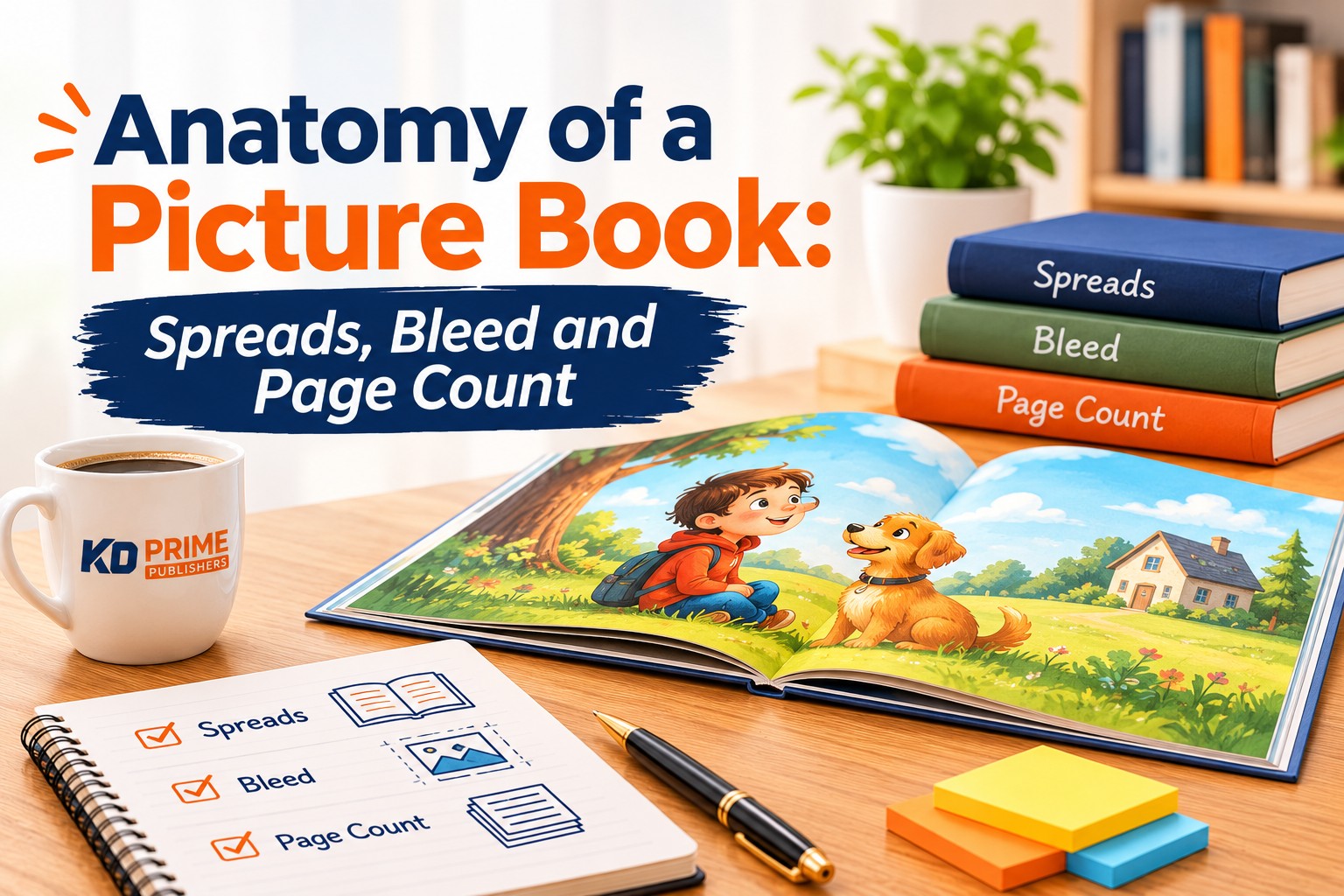
Anatomy of a Picture Book: Spreads, Bleed and Page Count
To plan your page count well, you need to understand how the pages of a picture book are actually built. Here are the terms that matter.
Pages vs Spreads
A page is one side of a leaf of paper. A spread is the pair of facing pages you see when the book is open. Illustrators and designers think in spreads, because a child looking at an open book sees both pages at once, and the artwork can run across the middle as one big image.
Printers, however, count pages. That difference trips up many first-time authors. When you hear "32 pages," you are not looking at 32 separate scenes or even 16 spreads of story. You are looking at a structure with fixed jobs for several of those pages.
What a 32-Page Picture Book Contains
Here is a typical breakdown of a 32-page interior.
- Page 1: Half-title page or full title page
- Page 2: Copyright information, ISBN and dedication
- Pages 3 to 4: The rest of the front matter, or the start of the story
- Pages 4 to 29: Story pages
- Pages 30 to 31: Back matter, such as an author note, a teaser for your next book or a short activity
- Page 32: Usually left blank or reserved by the printer
The exact layout varies from book to book, but the lesson is always the same. Your story has about 24 to 28 pages to work with, not 32. If you plan your illustrations as though every page is available, you will run out of room.
How Many Spreads Are in a 32-Page Picture Book?
This is where many creators miscalculate. Thirty-two pages does not give you 16 story spreads. With page 1 sitting alone on the right when the book opens, a 32-page interior has 15 facing pairs, from pages 2 and 3 through pages 30 and 31, plus the first and last pages standing alone. Front and back matter use several of those pairs.
A story that runs from page 4 to page 29 fills 13 complete spreads. That is why experienced picture book makers plan for 12 to 14 scenes, not 16.
You also have a choice about where the story begins. If you start on page 3, a right-hand page, your opening is a single page, which suits a quiet, simple introduction. If you start on page 4, a left-hand page, your first scene spans pages 4 and 5 as a full spread, which gives a dramatic opening more room to breathe.
Bleed
Bleed is artwork that extends past the line where the page will be cut. Printers cannot trim paper with perfect precision, so if your illustration stops exactly at the edge, you risk thin white slivers along the border. Extending the art slightly past the trim line solves that.
For Amazon KDP, the guideline is to add about 0.125 inch to the width and 0.25 inch to the height of your trim size. An 8.5 by 8.5 inch book, for example, becomes an 8.625 by 8.75 inch file. If even one page has artwork running to the edge, set up the entire file with bleed. You can check the current numbers in the KDP bleed and margin guidelines.
Gutter and Safe Margins
The gutter is the inner edge of each page, close to the spine, where the pages curve into the binding. Some of the image is always lost there, and text placed in the gutter becomes hard to read.
Keep faces, hands and any important detail away from the center fold. Keep text away from the trim edges too. Printers set minimum margins, but those are minimums, not targets. Giving yourself about 0.5 inch of safe space on every side protects your layout from small trimming shifts.
Trim Size and Page Count
Trim size is the final dimension of the book after trimming. Square formats like 8.5 by 8.5 inches are the most popular choice for self-published picture books because they are widely available and work well for both character close-ups and wide scenes. Landscape formats suit sweeping settings and journeys, but some large sizes are only available through offset printing or IngramSpark. Pick your trim size before the final artwork, because it changes how every spread is composed.
Picture Book Page Count by Age and Format
Not every children's book follows the 32-page standard. Page count and word count change with the age of the reader, and this table shows the usual ranges.
| Format | Reader age | Typical word count | Typical page count |
|---|---|---|---|
| Board book | 0 to 3 | Up to 100 | 12 to 24 |
| Early picture book | 2 to 5 | 100 to 400 | 24 to 32 |
| Standard picture book | 3 to 7 | 400 to 800 | 32 |
| Nonfiction picture book | 5 to 9 | 1,000 to 2,000 | 32 to 48 |
| Early reader | 5 to 8 | 1,000 to 2,500 | 32 to 64 |
Younger readers get fewer words and simpler scenes, so board books can be as short as 12 pages. Nonfiction picture books run longer because facts, diagrams and sidebars need space, which is why they often stretch to 40 or 48 pages. Early readers sit between picture books and chapter books, with more text and more pages.
Regional habits matter too. In some markets, such as Australia, picture book word counts tend to run shorter, because the illustrations are expected to carry more of the story. If you plan to sell mainly in the United States, aim for the ranges above.
Page Count and Word Count: How They Work Together
Page count and word count are two halves of the same decision. A 32-page picture book with 24 to 28 story pages usually carries about 400 to 800 words in total, with 500 as a safe target for fiction. That works out to roughly 15 to 30 words per page, and fewer on pages where the art does the talking.
Once a fiction manuscript passes about 1,000 words, many agents and editors pass on it, because the text starts to crowd the illustrations. The best picture book texts leave room. If the picture shows the red wagon rolling down the hill, the words do not need to say it.
Here is a simple way to test your fit. Divide your word count by 12 to 14, the number of spreads you actually have. If the result is 30 to 40 words per spread or fewer, your text is probably in a good range. Read it aloud, too. Picture books are read out loud hundreds of times, so rhythm, repetition and page turns matter as much as the raw count.
Rhyming stories deserve extra care. Rhyme and meter need room to land, and a forced rhyme to fill a page is a common reason manuscripts feel padded. If you want help shaping a manuscript to fit the format, children's book writing support can tighten the text before you commission artwork.
Self-Publishing Page Count Rules: KDP and IngramSpark
If you are self-publishing, your printer's rules matter as much as industry convention. Always confirm the current numbers on each platform before you finalize your files, because limits change.
Amazon KDP. KDP sets a minimum of 24 pages for paperbacks and rounds your page count up to an even number when needed. Color interiors have extra rules. Short full-color picture books generally need premium color, because standard color is only available for much longer books. KDP hardcovers also require a higher minimum page count than a typical 32-page picture book, so a traditional 32-page hardcover is usually not possible through KDP.
IngramSpark. IngramSpark accepts shorter books, with a minimum as low as 16 pages, and offers hardcover options that suit 32-page picture books. Be aware that very short books have thin spines, so spine text may not fit, and IngramSpark may add its own manufacturing page. Check the details in IngramSpark's print file requirements before you finish your cover.
Both platforms expect your interior as a single PDF of individual pages in reading order, not two-page spreads. You can design in spreads, but you export in pages. Use 300 DPI images and embed your fonts. Many authors print paperbacks on KDP and hardcovers on IngramSpark, which is a reasonable way to cover both formats.
If you would rather not wrestle with printer specs, professional children's book printing and file setup can take care of page counts, trim sizes and proofs for you.
How to Plan Your Picture Book Page Count
A little planning before the art begins saves money and rework later. Follow these steps.
- Finish and count your text. Know your word count before you divide the story into scenes.
- Divide the story into 12 to 14 scenes. Treat each scene as one spread, and combine or cut anything that does not earn its place.
- Mark your page turns. Put the setup on a right-hand page and the payoff after the turn. Page turns are one of the best storytelling tools in a picture book.
- Build a dummy. Fold 8 sheets of paper in half and staple them to make a 32-page mock book. Sketch your scenes in rough form and flip through it. Problems with pacing show up quickly.
- Vary the layouts. Mix full-bleed spreads for big moments, vignettes with white space for quiet moments and smaller spot illustrations for quick beats. Identical layouts make a book feel flat.
- Choose your printer and trim size. Lock these in before final artwork so your files match from the start.
One common mistake is stretching a single-page image across a spread. Art composed for one page looks thin and unbalanced when widened. Plan each spread illustration as a spread from the first sketch. A team experienced in children's book illustration will do this for you, working from your dummy.
How Page Count Affects Cost and Quality
Page count is one of the biggest drivers of your budget. More pages mean a higher printing cost per copy, a thicker spine and more illustrations to pay for. Illustrators often price by the page or by the spread, so a 32-page book with 13 or 14 spreads of art costs noticeably less than a 48-page one.
Color matters as well. Full-color interiors cost more per copy than black and white, which is a large part of the reason that picture books cost more to print than novels. If you are also hoping to keep your retail price competitive, a tighter page count helps.
Shorter is not always better. A book that is too short feels thin and leaves no room for a satisfying arc. Aim for the format your story actually needs, and spend the budget where it shows: strong artwork, clean layout and careful proofing.
Common Page Count Mistakes to Avoid
- Assuming all 32 pages are story pages. Front and back matter take several.
- Planning 16 scenes. You have room for about 12 to 14.
- Choosing a page count that is not a multiple of 8. You will pay for blank pages anyway.
- Putting faces or text in the gutter. Detail disappears into the binding.
- Mixing bleed and non-bleed pages. Set up the whole file with bleed if any page needs it.
- Ignoring printer minimums. Check page limits and color rules before the art is final.
When to Hire a Picture Book Publishing Team
Doing everything yourself is possible, but a picture book has many moving parts: manuscript, illustration, layout, print specs and distribution. It may be time to bring in help if you are unsure how to format files for KDP or IngramSpark, you do not have an illustrator, you are juggling several freelancers, or you have a launch date you cannot afford to miss.
When you compare providers, ask what is included, who owns the rights and final files, how many revision rounds you get and what the total cost is. A good team keeps you in control of your book. KD Prime Publishers handles editing, illustration, formatting, printing setup and distribution under one roof, with book publishing services built for authors across the USA.
Frequently Asked Questions
Most picture books are 32 pages. Page counts come in multiples of 8, so 24, 40 and 48 pages are also common. The story itself usually fills about 24 to 28 of those pages, with the rest used for the title page, copyright page and back matter.
No. Thirty-two pages is a convention driven by printing economics, not a strict rule. You can publish a 24-page or 40-page picture book, especially if you self-publish. Check your printer's minimums and choose a length that suits the story.
Most fiction picture books run 400 to 800 words, with about 500 as a safe target. Nonfiction picture books can run 1,000 to 2,000 words. That averages out to roughly 15 to 30 words per page, since the illustrations carry much of the story.
A 32-page interior has 15 facing pairs of pages, but front and back matter use some of them. A story running from page 4 to page 29 fills 13 full spreads, so plan for 12 to 14 scenes rather than 16.
Yes. A 24-page picture book works for simple stories and younger readers. It leaves roughly 18 to 20 story pages after front matter, so the text must be very tight. Confirm that your printer accepts 24 pages for your chosen format and color option.
A standard 32-page picture book usually needs 12 to 14 spreads of artwork, or around 24 to 28 pages of illustration. Many books also add a few spot illustrations. The exact number depends on your layout and how much each page carries.
Conclusion
Picture book page count looks like a small technical detail, but it shapes everything from your story structure to your printing bill. The standard is 32 pages, the count moves in multiples of 8, and only about 24 to 28 pages are really yours for the story. Plan for 12 to 14 spreads, keep faces and text out of the gutter, build your layout with bleed and safe margins, and check your printer's rules before the artwork is final.
If you want expert help turning a manuscript into a finished, print-ready picture book, KD Prime Publishers can guide you from page planning and illustration through formatting and publishing. And if you are still shaping your idea, the SCBWI guidelines for picture book authors are a useful place to learn what editors expect.
 DMCA
Disclaimer
